Electric vehicles have changed what a stranded driver looks like in Berrien County. Ten years ago the call was a dead battery or an empty gas tank. Now a meaningful share of our calls are drivers sitting at 0% charge somewhere between the Indiana line and St. Joseph, with no way to add a few miles from a can.
The good news is that an EV out of charge is a simple problem to solve. The bad news is that it is very easy for the wrong operator to cause thousands of dollars of damage doing it. If you drive an electric car anywhere near the lakeshore, this is worth five minutes of your time.
Arndt’s Auto Towing runs 24/7 out of Benton Harbor, covering the corridor from New Buffalo and Three Oaks north through Bridgman, Stevensville, and St. Joseph.
The One Rule: An EV Goes on a Flatbed
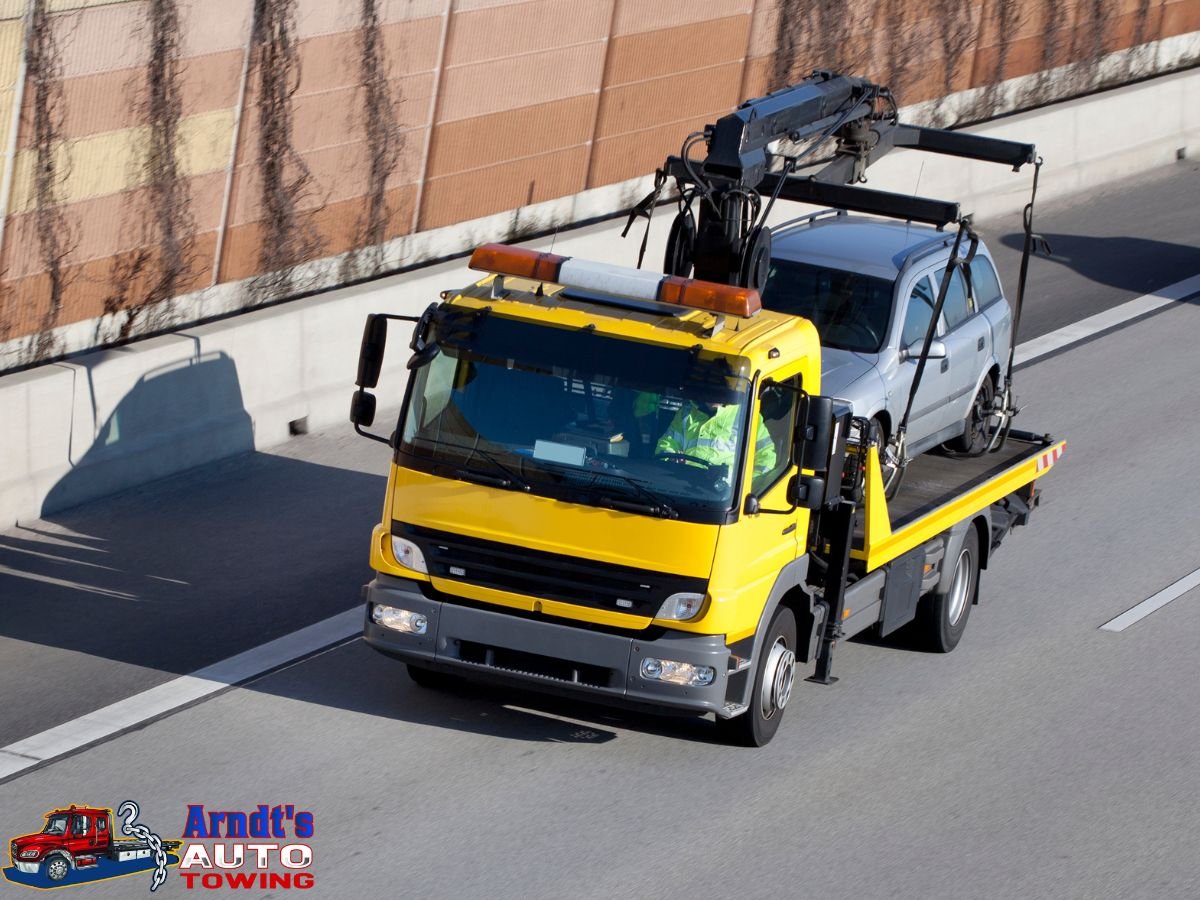
All four wheels off the ground. No exceptions worth arguing about.
Here is why. On a gas car, the wheels turning while it is towed is mostly harmless if the driveline is disconnected properly. On an electric car, the wheels are connected to electric motors, and turning those motors generates electricity. That is how regenerative braking works — it is a feature, not a fault.
Tow an EV with two wheels on the road and you are spinning those motors for the whole trip, feeding current into a system that is not expecting it and, if the pack is fully depleted, has nowhere sensible to put it. Depending on the vehicle you can damage the motor, the inverter, or the pack itself. On most EVs the manufacturer explicitly prohibits flat towing and wheel-lift towing in the owner’s manual.
There is a second, more mundane problem. Many EVs have no mechanical neutral in the way a conventional car does, and once the 12-volt system is asleep you may not be able to release the parking brake or shift at all. Some models have a transport or tow mode that has to be enabled before the vehicle is moved, and enabling it requires the car to still be awake.
So if a truck shows up with a wheel-lift and starts hooking your EV, stop them. That is not a preference. That is your drivetrain.
Why Drivers Run Out Here Specifically
Harbor Country is roughly ninety minutes from Chicago, which puts it right at the edge of a comfortable round trip for a lot of EVs — especially loaded with people and gear.
Several things then conspire. Charging along the lakeshore is thinner than it is in the metro areas people come from, and on a busy summer weekend the fast chargers that do exist can have a wait. Winter cuts usable range substantially — cold packs deliver less and cabin heat draws hard. Summer works against you too, with air conditioning running through slow traffic on the Red Arrow Highway. And drivers who plan to charge at their rental or a friend’s place sometimes arrive to find a standard outlet that adds a few miles an hour.
The result is a car that got here fine and cannot get home.
What to Do If You’re About to Run Out
- Stop somewhere useful while you still can. A parking lot, a rest area, an exit ramp — anything beats the shoulder of I-94. If you have 5% left, spend it getting somewhere safe rather than gambling on reaching a charger.
- Turn off climate control. Heat and air conditioning are the biggest draws after motion. Seat heaters use far less than cabin heat.
- Slow down. Range drops sharply with speed. Dropping from 75 to 60 mph on I-94 can buy you real miles.
- Hazards on if you are stopped, and get everyone out on the far side from traffic.
- Call with your location and your car’s year, make, and model. Say clearly that it is electric.
Where Should It Go?
This is the question worth thinking about before the truck arrives, because it decides the cost of the tow.
To the nearest fast charger. Usually the right answer if the only problem is charge. Twenty or thirty minutes on a DC fast charger and you are on your way. Worth checking the charger is actually working before we haul you to it — apps show status, and a broken charger at the end of a tow is a bad afternoon.
To where you are staying. If you have somewhere to plug in overnight, even slowly, that can beat sitting at a public charger.
Home, if home is Chicago or Indianapolis. For a mechanical fault rather than a flat pack, long-distance transport is often the practical answer rather than trying to solve it in an unfamiliar town on a Sunday. We handle long-distance towing and will give you a straight comparison.
To a dealer or qualified shop. Note that not every shop works on EVs. Worth confirming before the car is dropped there.
When It’s Not Just Charge
A few EV situations need more care, and you should flag them on the call.
A dead 12-volt battery. This surprises people. EVs still have a conventional 12-volt battery running the computers, locks, and displays, and when it dies the car is bricked even with a full main pack. Sometimes that is a jump start and you are moving. Tell us the symptoms and we will bring what is needed.
Any collision damage near the battery. The pack sits under the floor on most EVs, which is exactly where curb strikes, road debris, and undercarriage impacts land. A damaged high-voltage pack is a genuine fire risk and can reignite hours after an incident. Say so when you call.
Flood or standing water. Relevant here more than most places. If your EV has been sitting in water, treat it as a serious matter and mention it.
Warning lights, smoke, or an unusual smell. Get everyone well clear of the vehicle and call 911 before you call us.
Weight, and Why the Right Truck Matters
EVs are heavy. The pack alone can weigh over a thousand pounds, and full-size electric trucks and SUVs push well past what a comparable gas vehicle weighs. That is not a problem when the operator knows what is coming, but it is a real consideration for equipment selection and tie-down.
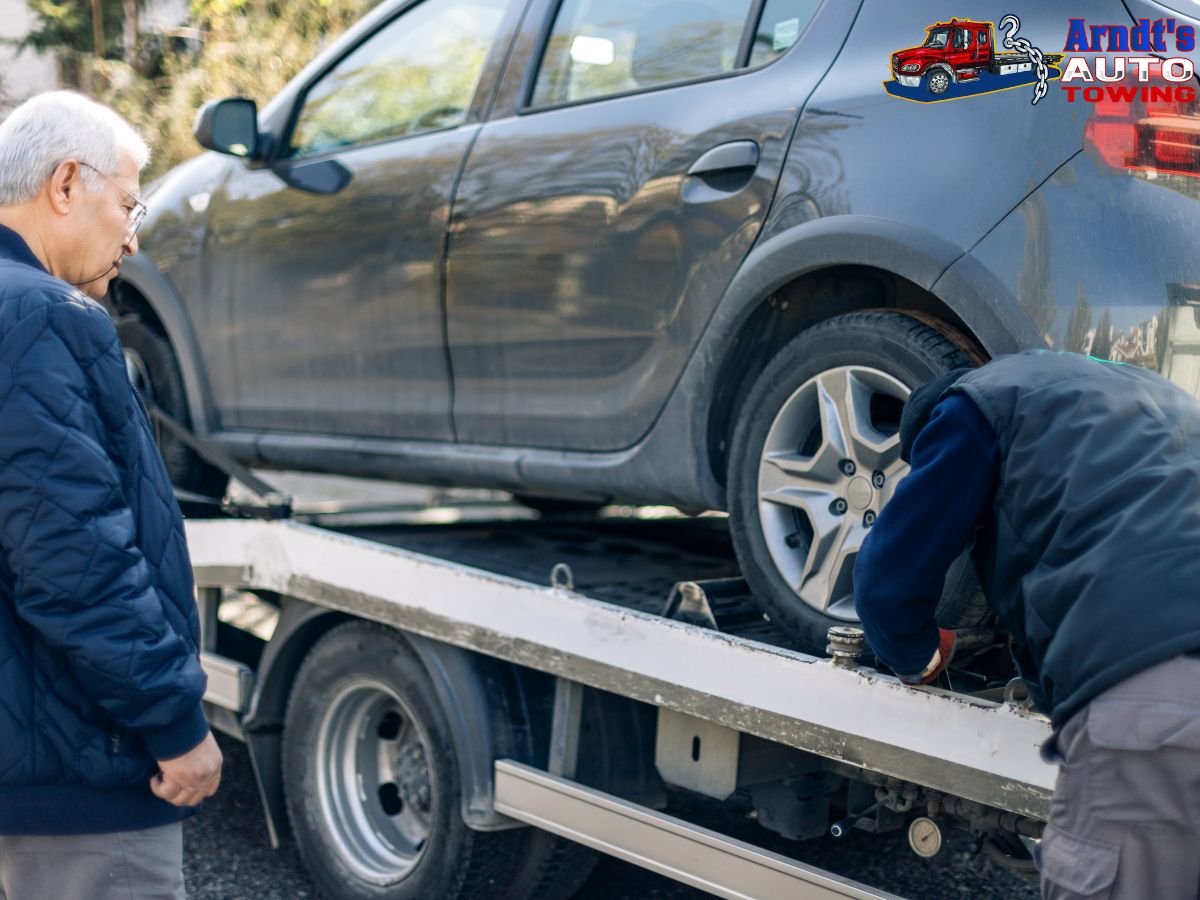
It also means securing the vehicle properly matters. Tie-down points differ on EVs, and hooking the wrong place risks the battery enclosure or the underbody panels. Give us the year, make, and model on the phone and the right truck comes the first time.
Frequently Asked Questions
Can you tow an EV with a wheel-lift for just a short distance?
We don’t. Check your owner’s manual and you’ll find most manufacturers prohibit it outright. Flatbed only, all four wheels off the ground.
Can you bring a charger out to me?
Mobile charging is not the same as a can of gas — adding meaningful range at the roadside is slow and impractical for most situations. The reliable fix is a flatbed to a working charger.
My EV is completely dead and won’t shift or release the brake. Now what?
Common, and manageable. Tell the dispatcher the car is unresponsive so the operator arrives prepared with the right equipment to load it without dragging locked wheels.
Do you tow Teslas, Rivians, Ford and Chevy EVs?
Yes. Give us the make and model and we’ll follow the correct procedure for that vehicle.
Will my insurance or the manufacturer cover this?
Many EVs include roadside assistance through the manufacturer, and some policies cover a charge-depletion tow. Coverage varies, so check your terms. We provide itemized receipts for reimbursement.
How far do you cover?
Benton Harbor, St. Joseph, Stevensville, Bridgman, Berrien Springs, New Buffalo, Buchanan, Niles, Three Oaks, Sawyer, Baroda, Watervliet, Coloma, Hartford, and surrounding communities — plus long-distance transport out of the area.
EV Stopped Somewhere in Berrien County? Call Before Anyone Hooks It.
Zero percent on I-94 outside Bridgman. Unresponsive in a New Buffalo parking lot. A dead 12-volt at a Sawyer rental with the whole car locked down.
Flatbeds, licensed and insured operators, 24 hours a day, and a straight answer about whether you need a charger or a shop.
Benton Harbor: (269) 925-8969 · Hartford: (269) 621-4282 — 24 hours a day, every day.
Find us at 952 Indiana Dr, Benton Harbor, MI 49022, or get in touch here. Learn more about flatbed towing, long-distance towing, and our 24/7 roadside assistance.
Damaged high-voltage battery systems are a fire hazard and should only be assessed by qualified technicians. If you see smoke, smell anything unusual, or the vehicle has been in a significant impact or flood, move well clear and call 911 first.