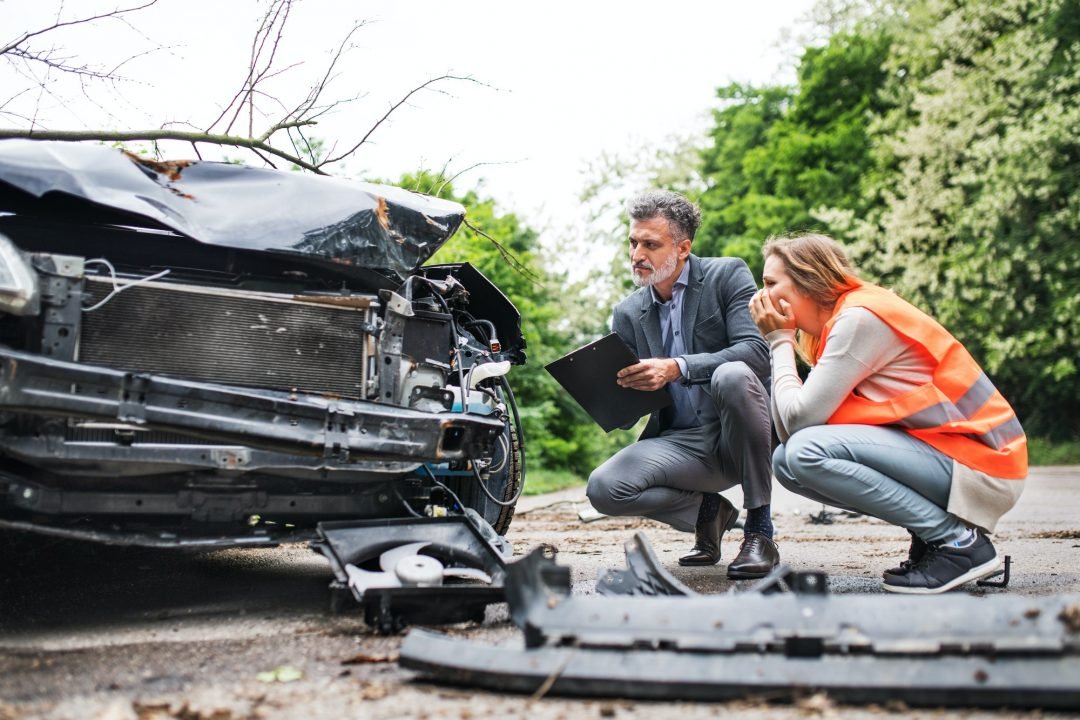
A collision on I-94 near Benton Harbor happens in seconds. Your car hits another vehicle or slides into a median. Time seems to stop. Your heart races. You’re shaken, possibly injured, surrounded by chaos.
In these critical first moments after an accident, most people are confused about what to do next. Do you move your vehicle? Do you call police? Do you call your insurance company first? Which towing company should you use? What about documentation for your insurance claim?
Over 15+ years serving the Benton Harbor area and all of Berrien County, our team has responded to thousands of accident recoveries. From multi-vehicle pileups on I-94 during rush hour to single-vehicle accidents on US-31, from intersection collisions in St. Joseph to rollover recoveries on county roads in Fair Plain—we’ve handled every accident scenario imaginable.
This guide walks you through the critical first steps after an accident, explains how professional accident towing and recovery works, and shows why choosing the right towing company matters for both your safety and your insurance claim. Whether you break down in Benton Harbor, St. Joseph, Stevensville, Bridgman, or any community we serve across Berrien County, this information could save you time, money, and stress.
Immediate Safety: The First 60 Seconds After Impact
Your immediate actions after an accident can mean the difference between life and death. Follow these steps:
Check Yourself and Passengers
Do you have injuries? If anyone in your vehicle is injured or experiencing chest pain, difficulty breathing, or neck/back pain:
- Call 911 immediately
- Tell them someone is injured
- Stay in vehicle unless there’s immediate danger
- Wait for emergency services
Is your vehicle safe? Before moving:
- Turn off the engine
- Check for leaking fluids (gasoline, coolant)
- Assess immediate hazards (broken glass, sharp metal)
- Listen for unusual sounds (hissing steam, creaking metal)
If your vehicle is not visibly damaged but won’t start or seems unstable, you’ll likely need emergency towing service for safe removal from the scene.
Move to Safety
If your vehicle is stopped on a highway (I-94, US-31, or major roads):
- Turn on hazard lights immediately
- If it’s safe and the vehicle runs, carefully move to shoulder
- If vehicle won’t move or feels unstable, don’t drive it
- Exit vehicle if safe to do so
- Move away from traffic
- Get passengers to a safe location (not on the road)
If you’re in an intersection or urban area (Benton Harbor, St. Joseph, downtown areas):
- Turn on hazard lights
- Exit vehicle only if safe
- Move to sidewalk or safe location away from traffic
- Don’t stand near your vehicle on the road
Document the Scene (Safely)
If it’s safe and you’re not injured:
- Take photos of vehicle damage (all angles)
- Take photos of accident scene and other vehicles
- Note road conditions (wet, icy, debris)
- Document other vehicles’ positions
- Note time, weather, lighting conditions
- Take photos of road signs and mile markers
This documentation is critical for insurance claims and our professional vehicle recovery service.
Call for Help: The Right Order of Calls
After ensuring safety, you need to contact the right people in the right order:
Step 1: Emergency Services (If Anyone Is Injured)
Call 911 if:
- Anyone has visible injuries
- Anyone is experiencing pain
- Anyone is unconscious or unresponsive
- You suspect injuries (whiplash, internal injuries can appear later)
- Your vehicle is blocking traffic or causing hazard
- There’s fire, smoke, or hazardous material
When you call 911:
- Tell them exactly what happened
- Provide your location (exit number, mile marker, cross street)
- Tell them if anyone is injured
- State how many vehicles are involved
- Describe vehicle types and colors
- Follow dispatcher instructions
Emergency services often coordinate with professional towing companies, so don’t hesitate to ask about towing when calling 911.
Step 2: Police Report (For Documentation)
In Michigan, you should file a police report for most accidents. Call the non-emergency police line:
- If accidents involve injuries → 911
- If accidents block traffic → 911
- If accidents are in intersections → 911
- If accidents are on highway → 911
- If only property damage and vehicles are mobile → Non-emergency police
Why a police report matters:
- Required by most insurance companies
- Provides official documentation of accident
- Establishes liability with police assessment
- Supports insurance claims
- Creates legal record
- Protects you in case of disputes
When police arrive, our vehicle recovery service team coordinates with them to safely remove vehicles.
Step 3: Insurance Company
After ensuring safety and calling police:
- Call your insurance company
- Tell them you’ve been in accident
- Tell them you’re not injured (or are injured)
- Tell them you’ve called police (if applicable)
- Ask about towing coverage (it’s usually included)
- Ask which towing companies they prefer
- Get claim number
- Ask about approved repair shops
Important: Many insurance policies include 100+ miles of free towing. Don’t use a non-approved towing company unless absolutely necessary.
Step 4: Professional Towing (Call Us)
Once you’ve handled emergency services and insurance, call Arndt’s Auto Towing:
Call: 269-925-8969
Tell us:
- Your exact location (exit number, mile marker, cross street)
- Type of accident (collision, rollover, single vehicle, multi-vehicle)
- Number of vehicles involved
- If anyone is injured
- Which insurance company you called
- Whether police are coming or already arrived
- Whether your vehicle is drivable or disabled
- Type of vehicle (so we bring right equipment)
Our dispatcher will:
- Send nearest available tow truck
- Provide estimated arrival time
- Give you dispatch reference number
- Advise on next steps
- Coordinate with insurance if needed
- Arrange safe recovery method
Why Professional Accident Towing Matters
Not all towing is the same. Accident recovery requires specialized expertise and equipment.
Understanding Accident Damage
When vehicles collide, the damage is often more extensive than visible:
- Frame damage that’s not obvious
- Suspension bent in ways that aren’t apparent
- Steering components compromised
- Brake lines ruptured (dangerous if vehicle is driven)
- Transmission fluid leaked (transmission won’t shift)
- Engine coolant leaking (engine will overheat and seize)
- Electrical systems damaged (vehicle won’t start or operates erratically)
Never assume your accident-damaged vehicle can be driven, even if it seems to start and move. Hidden damage can make the vehicle dangerous or cause additional damage during driving.
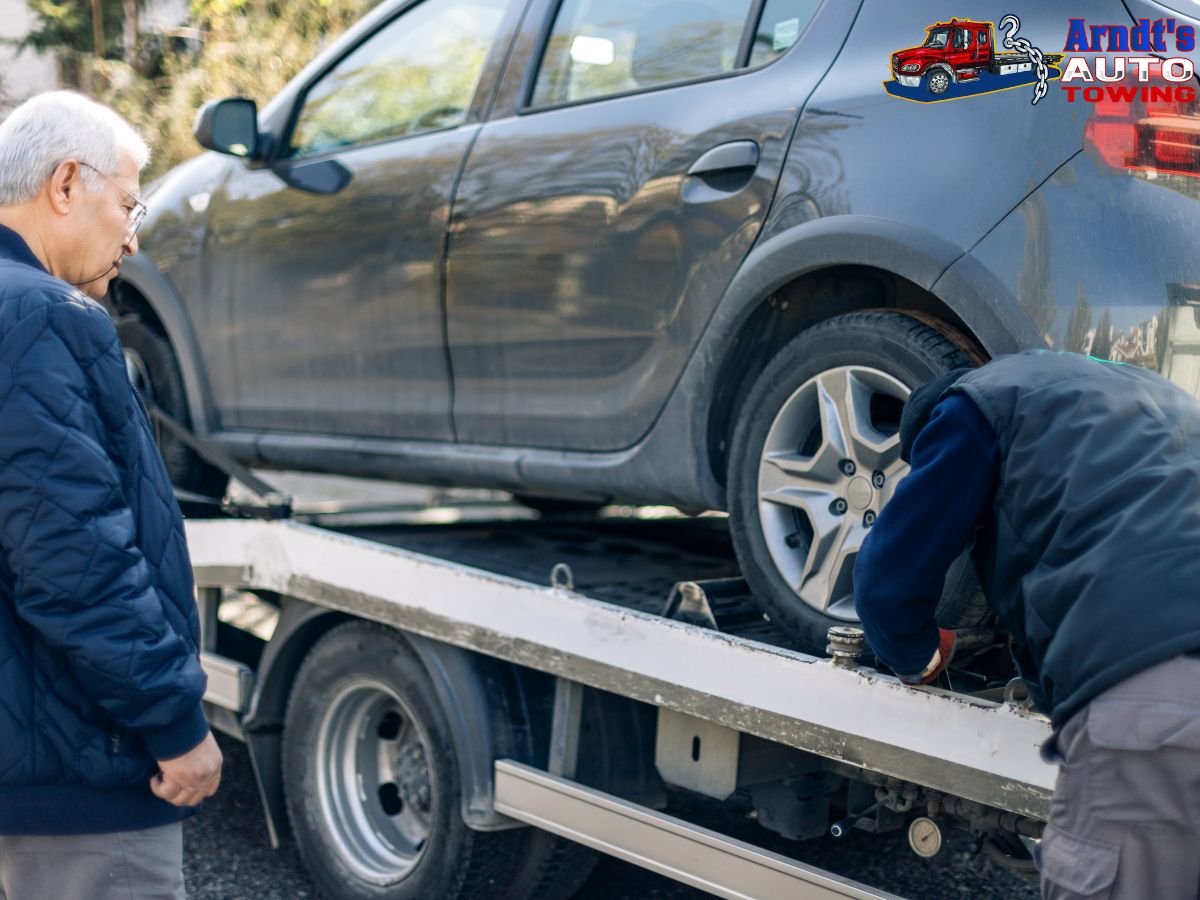
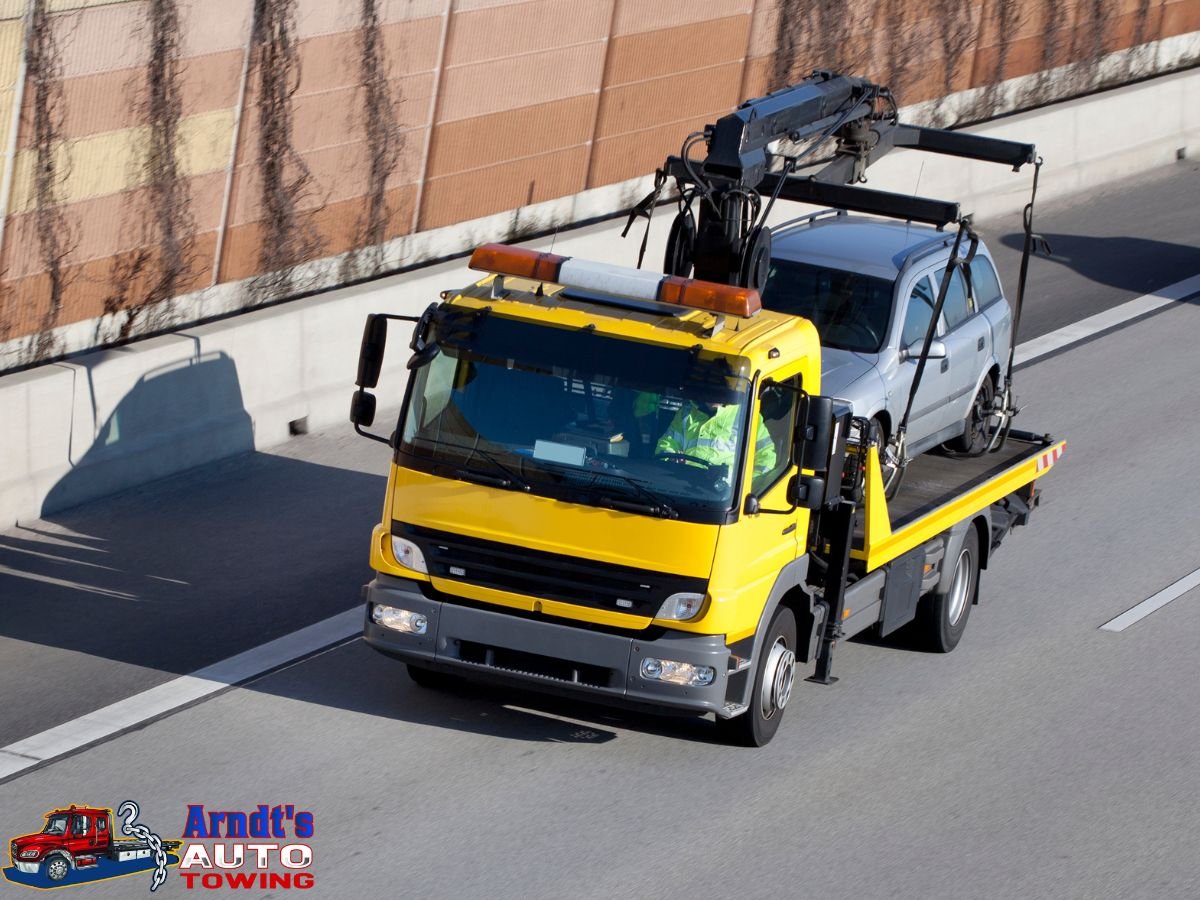
Flatbed Towing for Accident Vehicles
Accident recovery almost always requires flatbed towing, not traditional towing:
Why flatbed is critical after accidents:
- Prevents additional frame/suspension damage
- Doesn’t put weight on possibly-damaged wheels/axles
- Keeps vehicle stable (important if frame is bent)
- Protects undercarriage from ground contact
- Supports vehicle at multiple points
- Prevents additional electrical/mechanical damage
- Maintains vehicle integrity for insurance claims
An accident vehicle towed traditionally (wheels rolling) can incur $2,000-$5,000 in additional damage. Insurance companies recognize this and recommend flatbed towing.
Vehicle Recovery Service for Complex Accidents
Some accidents create complex recovery situations:
Multi-vehicle collisions: When 3+ vehicles are involved, coordinating recovery is complex. Our vehicle recovery service handles multi-vehicle scenarios with precision and safety.
Rollover accidents: Vehicles on their sides or roofs require specialized equipment. We use winches and heavy-duty recovery capability to safely upright vehicles.
Vehicles in ditches or off-road: Accidents on county roads or in rural areas sometimes leave vehicles in ditches or off-road. Our winch-out service safely recovers these vehicles.
Vehicles against obstacles: Accidents involving guardrails, utility poles, or building damage require careful recovery to prevent additional damage.
Accident Recovery Across All Vehicle Types
Accidents happen to all types of vehicles. Each requires different recovery approach.
Cars and Sedans
Car towing involves vehicles with:
- Low ground clearance (flatbed critical to avoid damage)
- Lighter weight (easier recovery but requires care)
- Compact size (can be positioned carefully)
- Often substantial cosmetic damage
After accidents, cars frequently need:
- Frame straightening assessment
- Suspension inspection
- Alignment checking
- Electrical system diagnostics
Trucks and Pickup Trucks
Truck towing involves larger vehicles with:
- Higher weight (requires heavier equipment)
- Different weight distribution
- Often carrying cargo (must be secured or removed)
- Possible commercial damage
After accidents, trucks need:
- Frame and suspension assessment
- Payload system inspection
- Brake system checking
- Electrical system verification
RVs and Large Recreational Vehicles
RV towing involves complex recovery:
- Extremely high weight (requires heavy-duty recovery)
- Axle complications
- Brake system complexities
- Living space integrity concerns
After accidents, RVs need:
- Complete damage assessment
- Structural integrity checking
- Utility system inspection (water, electrical, propane)
- Safety system verification
Motorcycles
Motorcycle towing after accidents requires extreme care:
- Vehicles are easily damaged by improper handling
- No integrated recovery points
- Require specialized securing
- Risk of operator injury if not handled properly
After accidents, motorcycles need:
- Damage assessment from every angle
- Component-level inspection
- Safety verification before riding
Luxury and Exotic Vehicles
Limo towing and exotic vehicle recovery:
- High-value vehicles requiring extreme care
- Complex mechanical systems
- Specialized parts and materials
- Premium finish protection
After accidents, luxury vehicles need:
- Paintless dent removal (if applicable)
- Component-level damage assessment
- Systems diagnostic checking
Commercial Vehicles and Buses
Bus towing and commercial vehicle recovery:
- Very heavy equipment
- Complex brake and air systems
- Multiple axles and tire configurations
- Passenger safety concerns
After accidents, commercial vehicles need:
- Complete system diagnostics
- Safety equipment inspection
- Regulatory compliance verification
Documentation for Insurance Claims: What Professionals Provide
Insurance companies require specific documentation for accident claims. Professional towing companies provide this:
At-Scene Documentation
Our team provides:
- Photos of vehicle from all angles: Shows damage for claim assessment
- Photos of accident scene: Establishes context
- Photos of other vehicles: If applicable
- Photos of road conditions: Documents hazards, weather, debris
- Written description of accident: Professional assessment of what occurred
Recovery Documentation
We provide:
- Detailed recovery notes: How vehicle was recovered, what equipment used
- Photos during recovery: Shows damage status and recovery process
- Damage assessment: Professional opinion on visible damage
- Special handling notes: If vehicle required special care
- Final position documentation: Photos of vehicle after recovery and positioning
Official Records
We provide:
- Receipt for services: Shows towing company, time, distance, charges
- Service invoice: Itemizes services provided
- Authorization documentation: If insurance company directed us
- Contact information: For insurance company follow-up
This documentation is critical for insurance claims. Never accept towing from non-professional services that don’t provide complete documentation.
Accident Response Across Berrien County
We maintain 24/7 accident response capability across all our service areas:
Highway Corridors
I-94 Emergency Response:
- Highest-accident location in our service area
- Multi-vehicle accidents common during rush hour
- Flatbed towing standard for I-94 accidents
- Heavy-duty recovery for complex multi-vehicle scenarios
- Fastest response times due to equipment positioning
US-31 Accident Coverage:
- Secondary highway with significant accident rate
- Often single-vehicle accidents (driver error on curves)
- Rural accidents (vehicles off-road)
- Bridge approach accidents (common in winter)
- We maintain equipment positioned for rapid US-31 response
Local Roads and Intersections
Benton Harbor and St. Joseph:
- Intersection accidents requiring careful recovery
- Multi-vehicle urban collisions
- Pedestrian-involved accidents (require police)
- Commercial vehicle accidents
Residential Areas:
- Fair Plain, Stevensville, Bridgman accidents
- Property damage from road incidents
- Driveway and private property accidents
- Winch-out recovery for off-road incidents
Remote Areas:
- Paw Paw, Marcellus, Lawrence accident coverage
- Rural road accidents
- Low-traffic area incidents
- Long-distance to professional help
We serve all service areas with the same professional accident response.
Our Towing Capabilities for Accident Recovery
Different accidents require different equipment:
Flatbed Towing
Flatbed towing is our primary accident recovery method:
- Supports vehicle at multiple points
- Prevents additional damage
- Stabilizes bent vehicles
- Protects undercarriage
- Maintains insurance claim integrity
Heavy-Duty Recovery
Heavy-duty recovery handles complex accidents:
- Multi-vehicle incidents
- Large commercial vehicles
- Complex positioning scenarios
- Vehicles requiring specialized equipment
Wheel-Lift Service
Wheel-lift towing for simple accidents:
- Minor damage, vehicle still mobile
- Single-point lifting appropriate
- Cost-effective for straightforward situations
- Not recommended for severe accident damage
Medium-Duty Towing
Medium-duty towing for mid-range incidents:
- Between standard and heavy-duty
- Common for accident recovery
- Handles most vehicle weights
- Appropriate for most accident scenarios
Light-Duty Towing
Light-duty towing for minor accidents:
- Vehicles with minimal damage
- Still operational but not drivable
- Small vehicles only
- Cost-effective for simple scenarios
See all our towing capabilities and understand which method suits your accident scenario.
Professional Services for Accident-Related Issues
Beyond towing, accidents create specific service needs:
Mechanical and Electrical Issues
Engine damage inspection: Our engine repair service identifies accident-related engine damage.
Electrical system damage: Our electrical service assesses accident-related electrical failure.
Brake system failure: Our brake repair service identifies brake line damage or hydraulic failures.
Transmission problems: Our transmission service handles transmission failure after accident impact.
Steering and suspension: Our steering and suspension repair service addresses impact damage.
System-Specific Issues
Heating/cooling failure: Our heating and air conditioning service identifies coolant leaks from collision.
Drivetrain damage: Our drivetrain services assess impact-related damage.
Fuel system damage: Our fuel and gas service identifies fuel line ruptures.
Muffler damage: Our muffler system service handles exhaust system damage.
Recovery-Specific Services
Vehicle recovery coordination: Our vehicle recovery service manages complex multi-vehicle scenarios.
Ditch recovery: Our winch-out service safely removes vehicles from ditches and off-road locations.
Long-distance transport: Our long-distance towing service transports accident vehicles across Michigan to repair facilities.
Accident Coverage Across Service Areas
We maintain full accident response capability in every community we serve:
Primary Areas with Heavy Accident Traffic:
- Benton Harbor – I-94 accidents common
- St. Joseph – Twin city coverage
- Stevensville – Highway corridor
- Bridgman – Collision hotspot
Secondary Areas with Regular Accidents:
- Berrien Springs – East county coverage
- Hartford – Secondary location
- Paw Paw – South county
- Marcellus – Remote area
- Bloomingdale – Far south
- Lawrence – Remote region
Complete coverage across entire service area.
What Sets Professional Accident Recovery Apart
Accident recovery is different from standard towing:
Insurance Coordination: We work directly with insurance companies and understand their requirements for coverage and claims.
Documentation Excellence: Professional photos, notes, and records support insurance claims rather than complicate them.
Specialized Equipment: Flatbed trucks, winches, and heavy-duty equipment aren’t found at every towing company.
Safety Priority: Years of accident recovery experience mean we know the safest recovery method for each situation.
Damage Prevention: Professional recovery prevents additional damage that could exceed original accident damage.
Regulatory Compliance: We follow all legal requirements for accident scenes, scene preservation, and documentation.
Contact Arndt’s Auto Towing: Accident Recovery 24/7
When accidents happen, you need professional help immediately.
Arndt’s Auto Towing 📍 952 Indiana Dr, Benton Harbor, MI 49022 📞 269-925-8969 (24/7 Emergency Line)
We’re available around the clock, every day of the year, for accident towing and professional recovery throughout Berrien County.
Learn more about our services, towing capabilities, service areas, and our team.
Check our gallery to see our professional recovery equipment. Have questions? Contact us anytime.
Frequently Asked Questions: Accident Towing and Recovery
Should I move my vehicle after an accident?
Only if it’s completely safe and your vehicle is drivable. If you can safely move to the shoulder, do so. If you’re on the highway and the vehicle won’t move, stay inside with seatbelt on and call us at 269-925-8969. We’ll provide emergency towing service.
Do I have to accept the towing company my insurance recommends?
No. You can choose any licensed towing company. However, insurance companies often recommend specific companies because they provide good service and documentation. We work with all major insurance companies.
Will flatbed towing cost more than regular towing?
Yes, but the insurance companies understand this and account for it. Given that traditional towing can add $2,000-$5,000 in damage, flatbed towing’s extra cost is worthwhile. Most insurance policies cover flatbed towing.
What happens if my vehicle is damaged beyond repair?
Insurance companies total vehicles based on repair cost exceeding a percentage of vehicle value (usually 75-85%). Our professional vehicle recovery service documents the damage accurately, supporting the insurance company’s assessment.
How quickly can you respond to an accident?
We maintain 24/7 dispatch and strategically positioned equipment. Response times depend on location, but we prioritize accident scenes above all other calls. Call 269-925-8969 immediately.
Do you provide accident towing in all areas (Benton Harbor, Paw Paw, Marcellus, etc.)?
Yes, we cover the entire Berrien County region including all our service areas. No location is too remote.
What types of vehicles can you recover from accidents?
All types. We handle car towing, truck towing, RV towing, motorcycle towing, limo towing, and bus towing.
What documentation should I keep after an accident?
Keep police report numbers, insurance claim numbers, photos you took, names and phone numbers of other drivers, witness contact information, and our receipt/invoice. This documentation supports your insurance claim.
What if the accident was my fault?
Your insurance company still covers towing. Call them first, then call us. We handle towing regardless of fault determination.
Should I get an independent damage assessment?
You can if you wish, but professional towing companies like us can provide initial damage assessment. Insurance companies then send their own adjuster.
Arndt’s Auto Towing: Professional Accident Recovery for Benton Harbor & Berrien County
When accidents happen, you need a towing company that understands accident recovery, coordinates with insurance companies, and prioritizes damage prevention. We’re here 24/7.
Review our terms of service and privacy policy. Read more in our blog. Contact us with any questions about accident recovery or towing services.